

Deleting the first Section Break on Pleading Paper
CA Pleading paper formatting.
One of the most common pain points I see for solo attorneys and firms without support staff is formatting documents for filing.
Here's a guide solving a problem every California litigator eventually hits: Deleting the first section break the wrong way can wipe out your pleading paper's line numbers.
If you are in the post, go out to the blog main page and save the Visual Guide to your desktop for future reference!
If you're a small to medium sized law firm navigating the balance between growing your team and managing overhead, Asked + Answered can help! Whether you need help recruiting the right paralegal for a permanent hire or want outsourced paralegal support while you figure out your next move, we specialize in connecting attorneys with experienced legal talent — on your timeline and your terms. Reach out at: support@a3socal.com
CA’s Reggateon lawsuit from a Paralegal Perspective
This one hits close to home as a huge music lover, and a legal professional.
California central District case Cleveland Constantine Brown, et al. v. Rodney Sebastian Donald’s, et al., made an unprecedented ruling; allowing the case to move forward and be litigated. The case stems from allegations that the source beat for all Reggaeton (the Dembo rhythm) was created by a single called “Fish Market” by Jamaican group Steely and Clevie. The case targets 150 artists, decades of music and basically the entire genre of reggaeton! What’s not noted is the common practice in Jamaican (amongst other foreign music markets) tradition to not only directly sample/ remix/copy lyrics and sounds but to also take direct influence from previous songs and artists, as a building blocks to build the culture and community. Songs are often remixed, remade and heavily sampled without permission, and this is reciprocated by the artists within the community (genre).
If plaintiffs are victorious, it would mean music genres and their elements can be owned, copyrighted and controlled.
In a world where we not only have communities seeking duplicity in sound, but also ai facilitation of mass reproduction and perfection of it; where does that leave artist’s creatively? Can they authentically make the sound they grew up to and love? Or do they need to pay the artists that influence their sound, unless they all working from ground zero creatively?
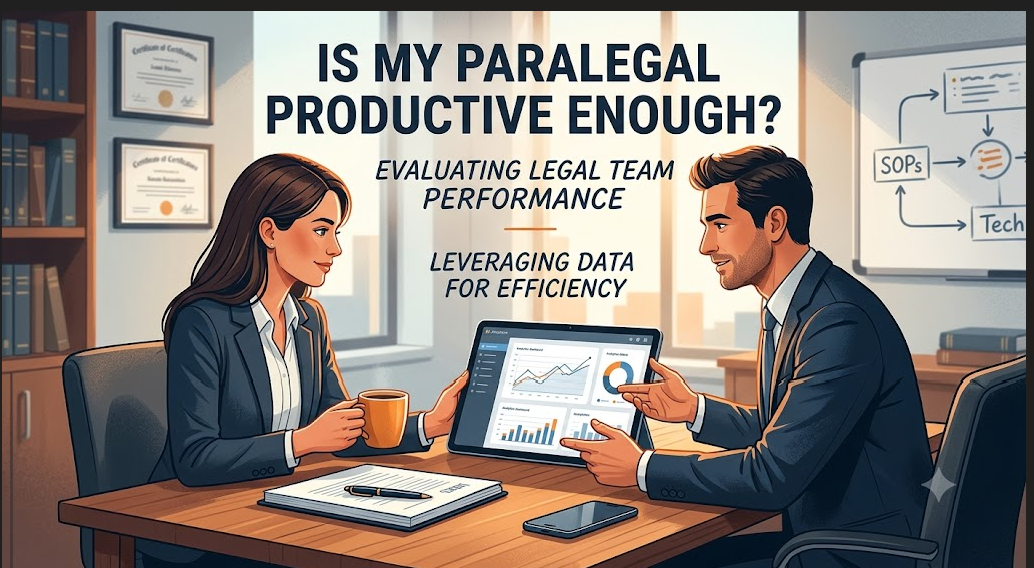
Is My Paralegal Productive Enough?
Ever wondered if your paralegal is working too slow?
[PLEASE NOTE: The following is not written using AI, these are my personal thoughts]
A common small law firm growth catch 22 is being slightly understaffed needing your core team members (aka paralegals and associates) to work some overtime. Many firms face this peril at some point and it’s actually a great problem to have because it means you’re growing! The stress (and financial implications) of that growth can often lead to turnover. Staff can feel overwhelmed and managers unsure whether team members are pulling their weight. I’d like to address the latter and help you not only determine whether a paralegal is being as productive as they should be, but also offer one solution to the problem.
This issue typically comes up as the question, “does it take that long to do __ task”? And to that, my answer is always, “it did that time”.
There is no set amount of time it takes to do a particular task, because there are so many variables to each time the task is accomplished. The best way to find out if your paralegal is being productive is through historical data. Here is the process:
-We can leverage AI and get a range for the task (be careful to give as much information as possible in the prompt).
-Then we can run a report from the billing software to find out how much time the task takes firmwide (including the attorneys).
- Lastly, we can run another report to see how long a particular paralegal is taking to accomplish the task.
IF the paralegal consistently takes slightly longer, I wouldn’t fret, but if you find it to be a general theme with their work, you may address it. Be mindful, asking a paralegal to speed up may leave a larger margin for error.
The true fix is a review of the firm’s SOPs, technology use and the paralegal’s adherence to these. Often a slower paralegal is slower because they are accomplishing tasks in a less efficient manner.
With that, my advice is to talk with your team and review your SOPs and use of technology on tasks your paralegal is responsible for. You may address slower productivity from a firm wide angle, in which everyone on the team may be able to expand their bandwidth. Instead of pointing out how one team member is the weak link, you may strengthen the entire team; including yourself. Of course, this will cost the firm more time initially, in evaluating, developing and launching new protocols and technologies.
In the meantime, I suggest getting some part-time and/or temporary support for your firm. If you're a small to medium sized law firm navigating the balance between growing your team and managing overhead, Asked + Answered can help! Whether you need help recruiting the right paralegal for a permanent hire or want outsourced paralegal support while you figure out your next move, we specialize in connecting attorneys with experienced legal talent — on your timeline and your terms. Reach out at: support@a3socal.com

Best Practices for Handling Turnover and/or Time Off at a Small Law Firm
Tips for building an effective small collaborative law firm that works when a team member is out.
[PLEASE NOTE: The following is not written using AI, these are my personal thoughts]
#1 Overlap in functional knowledge
This is the most important concept to master. Ensuring multiple people at the firm have a functional knowledge of SOPs regarding specific tasks will ensure you are never left hanging when someone is out. Depending on the size of your firm, that may mean you have an understanding of how the firm handles tasks. The goal is not to have everyone know how to do everything, but instead have 2 people who can accomplish any task the way you prefer it to be done.
#2 Documented SOPs
The “worst case scenario” is that no one with functional knowledge has to complete a particular task; the reason is because it will take much more time and effort to complete the task. However it is important things get done, so having backup documentation of how to accomplish all tasks within the firm is a must! I suggest using a video platform like Loom, Teams (free) or Zoom to have someone walk through each step; this will allow the watcher to get a visual understanding/training on the task.
#3 Having additional staffing
I recommend having a team member working at least a few extra hours each week. This person can be a legal assistant, who wants to learn the ropes and become a paralegal or a freelancer, who takes the overflow tasks. This will make it easier for your firm to be flexible in the event of unexpected short staffing. It also allows the existing team members to feel better supported and less stressed.
If you're a small to medium sized law firm navigating the balance between growing your team and managing overhead, Asked + Answered can help! Whether you need help recruiting the right paralegal for a permanent hire or want outsourced paralegal support while you figure out your next move, we specialize in connecting attorneys with experienced legal talent — on your timeline and your terms. Reach out at: support@a3socal.com

Onboarding Essentials Small Law Firms Always Skip
Here are a few essential but necessary things I received at larger firms, but never at a small firm:
[PLEASE NOTE: The following is not written using AI, these are my personal thoughts]
In my 15+ years supporting attorneys, I’ve noticed small law firms can be less able to onboard efficiently and miss important information that I was given up front at larger firms.
Here are a few essential but necessary things I received at larger firms, but never at a small firm:
· Formal job description – what all I am expected and not expected to work on
· Firm contacts with a delineation of who to contact for what
· Standard operating procedures for my job duties
· Firm tech use and security rules regarding devices, email, spam/phishing, passwords, etc.
· AI use policy
· Non-discrimination policy
· Preferred vendor lists for specific services
· Policy for use of company accounts, credit cards, financials, expenses, etc.
If you're a litigation law firm navigating the balance between growing your team and managing overhead, Asked + Answered can help! Whether you need help recruiting the right paralegal for a permanent hire or want outsourced paralegal support while you figure out your next move, we specialize in connecting attorneys with experienced legal talent — on your timeline and your terms. Reach out at: support@a3socal.com

How Much Should I Pay a Paralegal in 2026?
Tips for deciding how much to pay your paralegal
[PLEASE NOTE: The following is not written using AI, these are my personal thoughts]
Compensation is one of the hardest business decisions to make as it affects your bottom line/operational budget and can be a deciding factor on how many staff members the practice can afford. To make matters worse, law firm owners don’t want to pay top dollar for a mediocre staff member.
In my 15 years+ in law firm operations I’ve gathered a few tips to give you an idea of what you should be paying your paralegal.
1- Understanding what compensation is:
Compensation is not just hourly pay. Alternative compensation includes benefits, bonuses, PTO, profit sharing and the like. There are of course other expenses that go along with having an employee such as taxes, payroll insurance, office space, supplies and app/platform subscriptions, etc. The full gamut should be considered prior to hiring, so you know what you are comfortable with offering.
2- Understanding what rate is considered “Fair”:
My go to resource for figuring out what you should be paying based on your paralegal role, location and the preferred level of expertise is Robert Half’s Legal salary calculator: https://www.roberthalf.com/us/en/insights/salary-guide/legal
I’d be remiss not to mention that experience level is highly impactful when understanding what fair compensation is. Your candidate’s experience level along with the desired skillset for your role should be matched. I’ve seen candidates walk away because they feel their not being fairly compensated for their level of skill; when often their level of skill is simply not needed for that particular role.
3- Compensation ranges:
I suggest using a range when posting a new opening as it gives you flexibility to bring on a candidate at a fair rate (for fair job performance) and to accelerate their pay accordingly once they’ve shown you how they perform. What I mean by that is: the starting rate would be at the low end of the posted range, with a 90-day review built in. From there, strong performers are eligible for a bonus, a pay increase, or both; it's 100% performance-driven, so the ceiling is really up to them. If the paralegal doesn’t get the additional compensation after the 90 days, you can revisit the topic bi-annually. This will afford you the opportunity to give critiques, which the team member can improve on and ultimately earn the desired compensation; while simultaneously ensuring you are not overpaying.
4- Sweeten the deal with other forms of alternative compensation:
I worked for a firm that gave profit sharing if we met certain criteria for performance. I also had a firm that would give additional PTO days to top performers. Law firm staff love PTO and offering extra PTO is an excellent way to get someone who is not 100% satisfied on the lower end of the pay range (I suggest offering an extra 3-5 days PTO if you are in this scenario).
Whatever you decide, be clear in your offer letter/employment contract so that the candidate understands what is on the table when it comes to compensation.
5- Discuss compensation prior to the interview:
I’m a huge proponent of “not wasting anyone’s time”! Many candidates in today’s job market will see the compensation as something they can negotiate; they will complete the interview process and then ask for much more money than the job [posting] ever offered. Make your compensation policy/plan clear before you waste your time and theirs.
If you're a small litigation firm navigating the balance between growing your team and managing overhead, Asked + Answered can help! Whether you need help recruiting the right paralegal for a permanent hire or want outsourced paralegal support while you figure out your next move, we specialize in connecting attorneys with experienced legal talent — on your timeline and your terms. Reach out at: support@a3socal.com

How Do Legal Recruiters Work and Should I Use One?
Understanding recruiter basics and whether it's worth their time.
[PLEASE NOE: I did not use AI to write this. These are my thoughts, based on my experience.]
Here’s how the typical legal recruiter works:
· Recruiters scour resumes and profiles from sites like LinkedIn, indeed and zip recruiter and do outreach;
· Recruiters build a database of candidates from previous job searches, previous communication and referrals;
· Recruiters post jobs as needed to get candidates for roles they have been assigned to fill.
· Recruiters have screening meetings and calls to get to know the candidate, their experience and an understanding of what they are looking for;
· Recruiters present all candidates they believe may be a good fit based on their resume and screening as a “shortlist of candidates”;
· Recruiters charge 25-35% of the candidates annual salary based on the job offer.
Recruiters DO NOT:
· Give preliminary skills and knowledge testing unless required by the firm they are executing a search for;
· Fully vet candidates;
· Give refunds and most don’t give placement guarantees.
You should work with a recruiter if:
· Neither you nor anyone on your team have time to complete the process in house.
Resume review & screening typically takes 8-25 hours
Interviewing typically takes 6-12 hours.
Decision, reference checking & offering/negotiation takes 2-5 hours
Onboarding can take 4-8 hours
Total time investment: roughly 20–50+ hours before the person even starts producing
· You have the operational budget to afford the additional expense;
· You want to avoid the spam that comes with job posting
· You don’t mind interacting with a high volume of candidates
The Asked + Answered approach to recruiting paralegals:
· 3 Well vetted candidates at a time – receive a profile highlighting their skills, knowledge, personality and experience;
· Volume reduction: we filter the spam, flakes and unqualified candidates to make sure you interview only the best candidates;
· Onboarding assistance;
· Low flat-rate pricing;
· Placement Guarantees;
If you're a small litigation firm navigating the balance between growing your team and managing overhead, Asked + Answered can help! Whether you need help recruiting the right paralegal for a permanent hire or want outsourced paralegal support while you figure out your next move, we specialize in connecting attorneys with experienced legal talent — on your timeline and your terms. Reach out at: support@a3socal.com